

Drainage & Flood Protection Design
Genoa Road Street and Drainage Improvements
GreenPoint Engineering was tasked by the City of New Orleans Department of Public Works to develop a comprehensive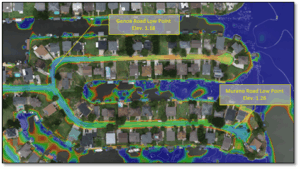 conceptual design for flood mitigation along Genoa Road in the Venetian Isles residential neighborhood. The area is susceptible to frequent street flooding caused by a combination of heavy rainfall and high tide events. The existing drainage infrastructure consists of side-of-road catch basins discharging to Bayou Sauvage, which has proven insufficient under current conditions.
The project included a thorough analysis of topographical, hydrological, and historical flooding data to inform design decisions. GreenPoint established hydraulic and stormwater design parameters and evaluated multiple solution scenarios aligned with varying levels of service. Each alternative was assessed for feasibility, constructability, and estimated cost. A key focus was identifying strategies that could be realistically implemented to provide near- and long-term flood relief, particularly during high tide events which impede system outflow.
Aerial Topographic Survey
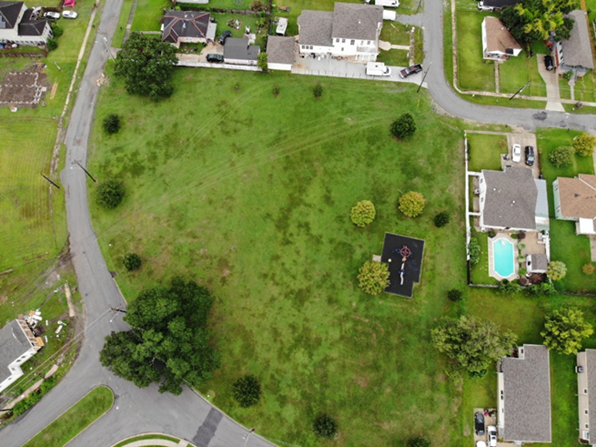
GreenPoint performed an aerial survey by drone to gather detailed elevation data describing the project area topography and to gather aerial imagery of the project area and its surroundings. Greenpoint integrated the drone data with a subconsultant’s utility survey and control points to generate a detailed surface of the project area, reflecting the existing conditions in greater detail and in three dimensions.
Tidal Data Analysis
GreenPoint conducted an extensive statistical analysis of over 15 years of hourly water level data from USACE Gage 85750, identifying a steady increase in Bayou Sauvage water surface elevation over time. The team focused on the most recent five years of data to better reflect current and projected conditions, and to establish realistic design criteria. These findings confirmed that the flooding affecting the residents of Genoa Road is caused by the accumulation of stormwater at the low points of the road and is compounded when the water surface elevation in Bayou Sauvage is greater than the low points of the road.
Alternatives Development
GreenPoint evaluated multiple flood mitigation alternatives for Genoa Road (and later Murano Road) based on achieving varying levels of flood protection, expressed as confidence intervals (99%, 99.5%, and 99.9%). Each alternative was assessed in terms of hydraulic performance, feasibility, compliance with the City’s minimum 0.3% longitudinal slope requirement, and involved raising the road elevation to meet a target level of service.
Backwater Flooding East of Morgan City
GreenPoint compiled and evaluated previous plan formulation efforts and environmental compliance information associated with the Atchafalaya Basin east of Morgan City to prepare an Engineering Documentation Report (EDR). The EDR was conducted to inform the Commander, U.S. Army Corps of Engineers (USACE), Mississippi Valley Division (MVD), whether a change in the project is warranted to fulfill the project’s contingent authorization. The EDR also identified the required analyses to formulate and construct an effective and implementable backwater flood risk reduction plan, consistent with the the comprehensive Flood Control, Mississippi River and Tributaries (MR&T) project and the Atchafalaya Basin Levee Project (ABLP) that incorporates regional concerns for flood risk management and project impacts.
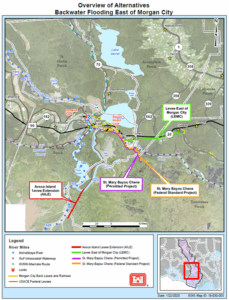 GreenPoint coordinated with the Regional Planning and Environment Division – South (RPEDS) of the US Army Corps of Engineers Mississippi Valley Division to incorporate the most recent technical investigations into the plan formulation effort.
Existing studies and reports, including the 2003 Lower Atchafalaya Basin Reevaluation Study, the 2010 Convey Atchafalaya River Water to Northern Terrebonne Parish Marshes and Multipurpose Operation of the Houma Navigation Lock Feasibility Study, and the recently submitted permit for the Bayou Chene Flood Protection Project from St. Mary Parish were incorporated into the assessment. The effort includes the assimilation of relevant plan formulation and NEPA compliance information, and assessment of flood damages and life safety impacts using the HEC-LifeSim model.
GreenPoint identified and addressed three existing action alternatives, including structural and non-structural measures, into an Engineering Documentation Report. The EDR also identified gaps associated with plan formulation and environmental baseline conditions and impact analyses that will be addressed to support plan development and selection.
Drainage Improvements for the City of New Orleans
GreenPoint Engineering provided engineering services to address drainage repairs across 43 sites across the City of New Orleans through Community Development Block Grant (CDBG) funding. In addition to the installation of new subsurface drainage, point repairs and catch basin adjustments, GreenPoint incorporated innovative design elements, including permeable pavement and green infrastructure where appropriate to divert, detain and reduce the volume of runoff immediately entering the drainage network.
To determine the full scope and cost of the needed repairs, GreenPoint first validated and characterized the drainage deficiencies to be addressed in the subsequent design phase. Using the record of the 98 sites within the DPW’s initial list of potential drainage needs, GreenPoint performed field investigations and subsequent analysis to determine the required course of action for each site, and developed pre-design level cost estimates for each repair.
Upon completion of the field investigations, GreenPoint cross-referenced each site requiring repair against the City’s on-going and planned projects to determine if any of the sites are captured within other DPW projects, including the JIRR program, and if those planned repairs will address the identified drainage issue. GreenPoint is proceeding with the design of improvements for the remaining sites, of which 25 require line repairs and catch basin adjustments and 15 require comprehensive drainage improvements. These comprehensive drainage improvements require the installation of new drainage infrastructure and associated street and utility repairs and more detailed hydraulic analysis and design.